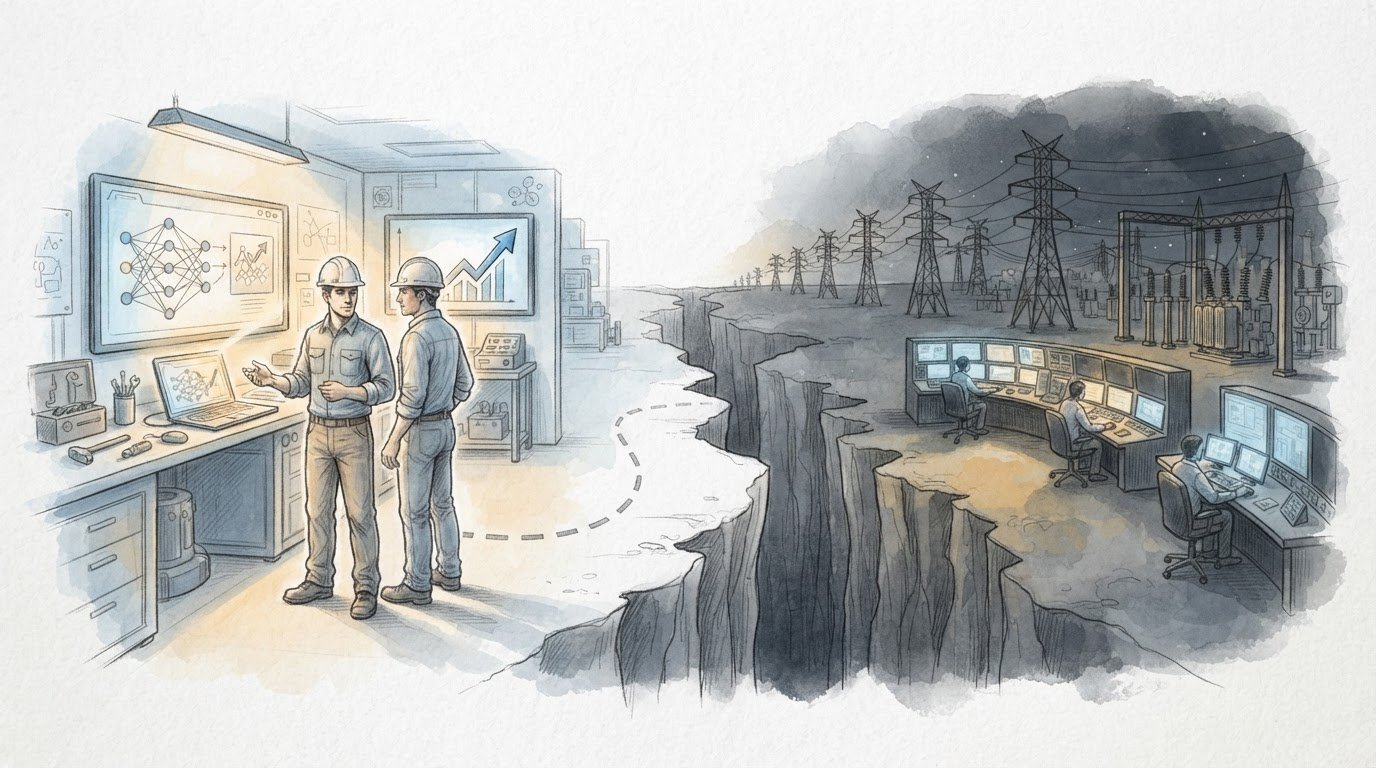
Every utility has the same graveyard. A machine-learning model that forecast load better than the incumbent method. A computer-vision system that caught cracked insulators in drone footage. An outage-prediction tool that beat the planners over a three-month trial. Each one worked. Each one was demonstrated to executives, written up, congratulated — and then quietly never entered production.
The reflex is to call this an execution failure, or to blame the vendor, the budget, or the model’s accuracy. It is none of those. The barrier between a utility AI pilot that works and a deployment that runs is almost never the technology. It is everything the pilot was carefully designed not to touch.
The model was never the hard part
A pilot is built to answer one narrow question: does the tool work? It almost always answers yes. Benchmarks clear, the accuracy beats the incumbent, the dashboard is persuasive. But clearing a benchmark and surviving a control room are not the same test, and the first predicts almost nothing about the second.
The evidence is in the aggregate, and its shape is the tell. Adoption is already near-universal: an Itron survey of 500 North American utility executives found 81% using AI in some form — 41% with it fully integrated, another 40% with mature projects underway. Yet BCG finds 74% of energy companies struggle to get real value from AI. Near-total adoption alongside near-total difficulty realizing it: the constraint is plainly not access to the technology. The models are mostly fine. The barrier, as one assessment of stalled energy-AI programs puts it, is not technological capability but organizational readiness. The pilot proved the model; it did not prove the organization could absorb it.
The anatomy of the gap
The power system has a structural habit of producing things that are ready but not running. As of 2025, 2,061 GW of generation and storage sat in US interconnection queues — roughly twice the installed fleet — with a median wait of well over three years to an agreement and more than five to commercial operation. Of everything that requested connection between 2000 and 2020, only 13% has come online; 75% withdrew. Readiness is abundant. Deployment is scarce. And the binding constraint is institutional, not technical.
An AI pilot dies in the same place, for the same kind of reason. Five barriers do the killing, and none of them is the model:
- Failure has no tolerance. A recommendation that is 92% right is a fine product until it runs on a system that must not go down. On the grid, the 8% is a liability no one will sign for, and a planner who can be overruled is replaced by an operator who needs to know exactly who is accountable when the model is wrong at 2 a.m.
- The data the model assumed does not exist. Pilots run on a clean, curated extract. Production data lives scattered across SCADA, the historian, CIS, GIS, spreadsheets — and, still, paper. One field program found production data so fragmented that paper tickets took 72 hours just to digitize. A model that was accurate on the extract degrades on the real feed.
- The pilot ran outside the OT boundary. A sandbox on the corporate IT network is not the control environment. Moving a model into the operational-technology layer — where cybersecurity, latency, and fail-safe behaviour are non-negotiable — is a separate and usually harder project than building the model was.
- Nobody owns it after the pilot. Pilots are owned by innovation teams and consultants; platforms must be owned by operations and asset management. The handoff — who supports it at 3 a.m., whose KPI it moves, whose liability it becomes — rarely happens cleanly, and an unowned system cannot graduate.
- The contract and the regulator were never in the room. Scaling means multi-year SLAs, vendor lock-in made explicit, and — uniquely for a regulated utility — a cost-recovery case to a commission. A pilot is engineered to avoid all three. A deployment cannot.
Underneath all five sits the workforce. Field engineers distrust a recommendation they cannot interrogate, and a model that arrives without an explanation is quietly ignored, whatever its accuracy.
The Deployment Gap
These five barriers are not a checklist of project risks to be managed one by one. They are one structural fact wearing five faces. A pilot tests a tool. A deployment requires an institution to change itself — to reassign ownership, rewrite contracts, re-train operators, re-architect data, and make a commitment it cannot easily reverse.
That is the Deployment Gap: the distance between a model that works and an institution willing to be changed by it. Demos test tools; deployments require institutional commitment, contractual redesign, and operational ownership. The gap is invisible inside every pilot, because the pilot was designed to sit on the near side of it — time-bound, lightly contracted, run by exceptional people, shielded from the control room. The more carefully a pilot is protected, the less it tells anyone about what lies across the gap.
Crossing it
The gap does not close by running more pilots or buying better models. It closes when a pilot is built, from the first day, to cross it. In practice that means naming the operational owner before the pilot starts rather than after it succeeds; designing the contract and the cost-recovery case for scale at the outset; bringing the regulator and the control-room staff into the room at the beginning, not the demo; and being willing to make the one selective, irreversible commitment that a platform requires and a pilot is built to avoid.
The tell is what the pilot is actually testing. An honest pilot does not ask whether the model works — that question is nearly always answered yes and nearly always beside the point. It asks whether the organization is willing to be changed by it. Most pilots never ask, which is precisely why most pilots never ship.
Why this matters now
The models improve monthly. The institutions do not. As AI capability races ahead, the Deployment Gap does not shrink — it widens, because the limiting factor was never on the technology side of it. Every advance in model quality that is not matched by institutional change simply adds to the graveyard of pilots that worked.
The utilities that pull ahead will not be the ones with the best models. They will be the ones that learned to cross the gap — that treat every pilot as a rehearsal for institutional change rather than a demonstration of technical possibility. Utility AI does not fail in the lab. It fails at the boundary between innovation and institution, and that boundary is the only place worth studying.
Sources
- Itron, 2025 Resourcefulness Report: Grid Edge Intelligence — survey of 500 US and Canadian utility executives; 81% already use AI in some form (41% fully integrated, 40% with mature projects underway). October 2025.
- Lawrence Berkeley National Laboratory, Queued Up: interconnection queue data (end-2025) — queue capacity, wait times, completion and withdrawal rates. As of 2025.
- Weaver, Beyond the Pilot: What’s Holding Back AI Scale in Energy — BCG’s 74% figure, the data-fragmentation example, and the organizational-readiness argument.
Leave a Reply