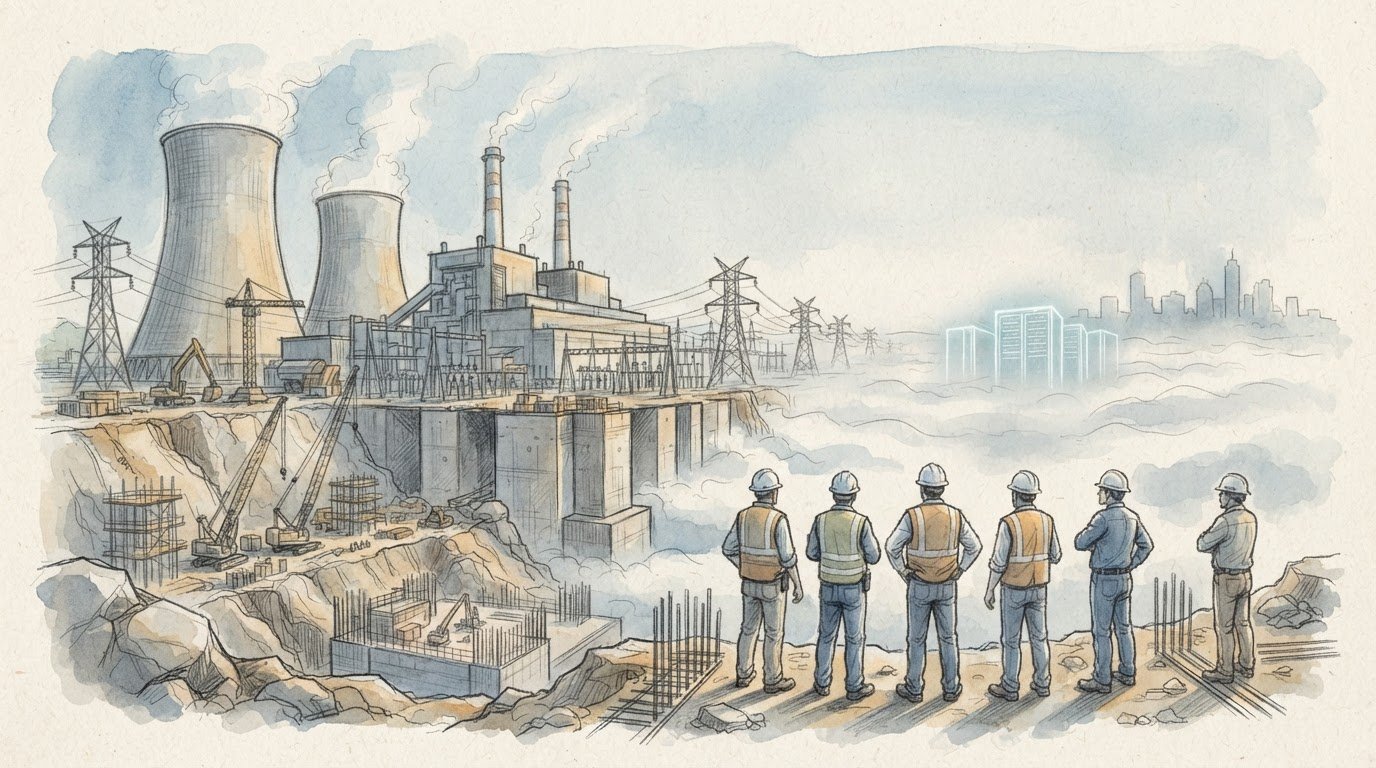
No utility gets to wait for the future to become clear before it acts. The assets it builds last for decades; the demand it is building for is a forecast, and the forecast is a guess. This is the defining condition of power infrastructure: you must bet before you can know.
And the one option that looks like avoiding the bet — waiting — is itself an irreversible bet, placed blind.
The fork
Right now the bet has a name: how much long-lived generation to commit for AI. Over 85 GW of new gas-fired capacity is in development in the United States, a figure that more than doubled in a year, driven in part by speculation about the electricity an AI build-out will need (Global Energy Monitor, February 2025).
What that build-out will actually need is genuinely unknown. The federal forecast puts data-center load at 11.8% of US electricity by 2030 — but its own scenario range runs from 9.5% to 15.3%, a spread of hundreds of terawatt-hours (Lawrence Berkeley National Laboratory, 2026). Utilities are being asked to commit thirty-year assets to a number that could be off by more than half. If the demand does not arrive, Global Energy Monitor estimates up to $85 billion in gas plants could strand.
Why the bet cannot be unmade
A gas plant is not a subscription you can cancel. It is a decades-long physical commitment: capital sunk, fuel and pipeline contracts signed, a place taken in the dispatch order, and a cost placed in the rate base that customers carry whether or not the plant ever runs hard. Once built, it is a fact on the system, not an option on a spreadsheet.
The lead times compound the lock-in. A plant and its grid connection take years to build, and interconnection alone already stretches past the point where the demand picture would have clarified. By the time a utility knows whether the AI load was real, the decision it made years earlier has already hardened. This is the Infrastructure Irreversibility Principle in its purest form: the commitment outlives the uncertainty that justified it.
Waiting is a bet too
Facing a forecast that could be off by half, the instinct is to wait for it to resolve. But on the grid, waiting does not sidestep the bet — it places a different one.
Being wrong by building is expensive and visible: stranded plants, a write-down measured in tens of billions, customers paying for capacity nobody uses. Being wrong by waiting is just as irreversible and far less visible: if the demand does arrive and the capacity was not started years earlier, there is no catching up, because the lead times do not shrink to meet the need. One error strands assets; the other forecloses the future. Neither is the safe choice, because there is no safe choice — only which bet, placed how deliberately.
Betting the reversible way
If the bet cannot be avoided, the Infrastructure Irreversibility Principle points to how to place it: as reversibly as the job allows. Not every commitment is equally hard to unwind. A decades-long gas plant is maximally irreversible. A battery installation or a renewable project is faster to build, cheaper to pause, and easier to resize — optionality the gas plant does not offer, and part of why those options now undercut gas on cost.
The discipline follows from that asymmetry: meet uncertain demand with the most reversible instrument that can do the job; stage commitments so each one buys information before the next is made; and reserve the fully irreversible bet for the moment the system genuinely forces it. The goal is not to predict the future. It is to stay solvent across more than one of them.
Why this matters now
The AI load surge has made this the defining grid decision of the decade, but it will not be the last to have this shape. Every transition ahead — deeper electrification, hydrogen, long-duration storage, whatever follows — presents the same structure: a long-lived commitment demanded before the scenario resolves.
The utilities that come through it well will not be the ones that forecast best. No one forecasts a range from 9.5% to 15.3% correctly. They will be the ones that bet in a way that survives being wrong. You must bet the grid before the future arrives. The only real choice is whether you bet deliberately.
Sources
- Global Energy Monitor, “U.S. Bet on Gas Plants to Meet Uncertain AI Energy Demand Risks $85 Billion in Stranded Assets” (February 2025) — 85+ GW of gas capacity in development and the stranded-asset estimate.
- Lawrence Berkeley National Laboratory, United States Data Center Energy Usage Report: 2025 Update (2026) — data-center load projected at 11.8% of US electricity by 2030, scenario range 9.5%–15.3%.
Leave a Reply