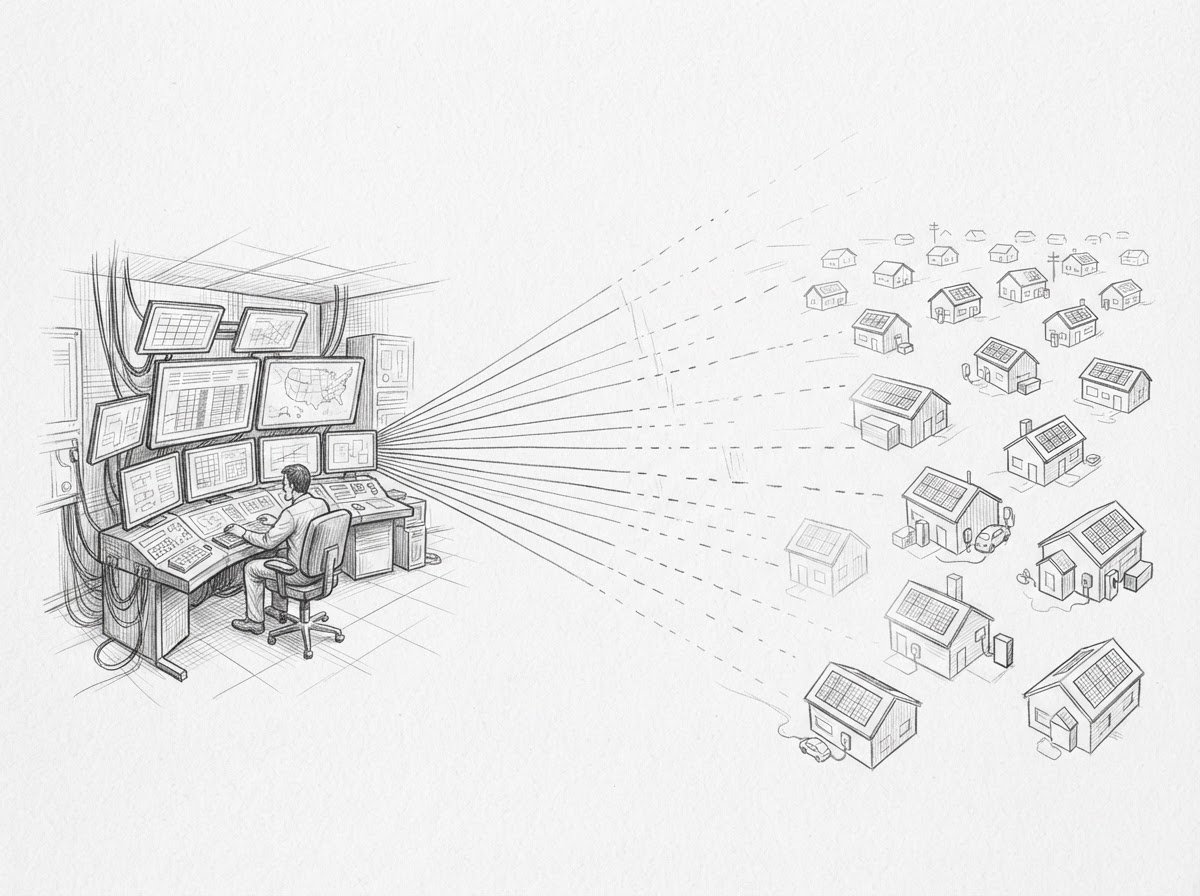
The grid runs on a control loop as old as the grid itself: sense, decide, act. Measure what the system is doing, decide what it should do, and send a command to make it happen. For a century that loop worked because the things worth controlling were few, large, instrumented, and reachable—power stations, transmission lines, substation breakers. A control room could see them and command them.
The distributed edge breaks that assumption on both ends. Behind millions of meters sit rooftop solar arrays, home batteries, EV chargers, heat pumps, and smart appliances. They now shape voltage, frequency, and power flow on the distribution network—but the operator can neither fully see them nor directly act on them.
This is the Grid-Edge Control Gap: the distance between the control the grid is assumed to have and the control it actually has once the assets that matter move behind the meter.
You cannot reliably control what you can neither see nor reach.
The edge is where the grid's central control model runs out.
The gap has two halves. One is observability—the grid cannot see what is happening behind the meter. The other is reach—even where it can see, it cannot physically act on millions of dispersed, unattended devices. Centralized control, extended to the edge, runs out of both sight and hands.
The Observability Half: Inferring, Not Seeing
Transmission operators enjoy dense, fast telemetry. Distribution networks were never built that way. Most feeders were designed to deliver power one way to passive consumers, with instrumentation thinning out rapidly past the substation. Behind the meter, there is often no grid-facing sensing at all.
So the operator infers. Load is estimated from historical profiles. Rooftop solar output is modelled from weather and installed-capacity registers that are frequently incomplete. Battery behaviour is assumed from tariff signals rather than observed. The result is a picture that is sparse, delayed, and partly fictional:
- Net metering shows consumption minus generation, hiding how much of each is actually flowing
- Behind-the-meter assets appear only as anomalies in aggregate feeder readings
- Fast events—voltage excursions, reverse power flow at midday—are seen after the fact, if at all
When the operator is inferring rather than seeing, every control decision inherits that uncertainty. You cannot tune what you can only estimate.
The Reach Half: You Can’t Dispatch a Technician to a Million Rooftops
Suppose the grid could see perfectly. It still could not act. A transmission operator curtails a generator with a single instruction to a staffed, instrumented plant. The equivalent action at the edge means reaching millions of small, unattended, consumer-owned devices—each behind a home broadband connection the utility does not control, governed by a warranty and an owner who did not sign up to be dispatched.
South Australia has run directly into this. With rooftop solar penetration among the highest in the world, midday distributed generation can approach total regional demand, driving the system toward dangerously low “minimum system load.” The response was telling: new rooftop systems must now be remotely curtailable, and the network operator built an emergency backstop mechanism to switch distributed solar off when the system is at risk—later softened into “flexible exports” that throttle rather than cut. Building that reach was a multi-year regulatory and engineering program for a single capability in a single state.
That is the reach problem in miniature. Direct control over the edge is not a feature you switch on; it is infrastructure you have to construct, device by device, standard by standard.
Why DERMS and ADMS Don’t Close the Gap
The industry’s answer is a new control layer—Advanced Distribution Management Systems (ADMS) and Distributed Energy Resource Management Systems (DERMS)—meant to extend the central loop out to distributed assets. These are necessary and genuinely useful. But they do not dissolve the gap; they relocate it.
A DERMS can only manage what it can observe and address. It still depends on edge telemetry that is sparse, on device registers that drift out of date, on communication paths the utility does not own, and on aggregators sitting between the operator and the asset. The control room gets a dashboard that looks complete. Underneath, it is still inferring and still reaching through intermediaries.
The danger is a familiar one in infrastructure: a clean interface that implies more control than exists. A DERMS that overstates its own observability can be worse than none, because operators act on it with misplaced confidence.
Attribution: When the Edge Misbehaves
Centralized grids have clear accountability. A plant trips; its owner is responsible. At the edge, cause and responsibility blur. When a feeder suffers voltage rise or an unexpected reverse flow, was it the solar inverters, the batteries, a mis-set tariff, a firmware update pushed by a manufacturer, or an aggregator’s dispatch? The devices are owned by consumers, configured by installers, governed by standards, and coordinated—sometimes—by third parties.
Diffuse control produces diffuse accountability. This is not a side issue. Control that cannot be attributed cannot be trusted, insured, or regulated—which means it cannot be leaned on when the system is under stress, exactly when it is needed most.
Scale Defeats the Central Loop
The deepest problem is arithmetic. A central control loop scales with the number of endpoints it must track and touch. Transmission has thousands of controllable assets. The distributed edge is heading toward tens of millions, growing faster than any centralized system can instrument, model, or command.
Past a certain density, the loop cannot keep up—not because the software is immature, but because the architecture is wrong. A single brain polling millions of endpoints over networks it does not own is not a scaling challenge. It is a structural mismatch.
What Actually Works: Push Intelligence Outward
The systems that cope with the edge stop trying to control it centrally and start designing for autonomy and coordination. The pattern is consistent:
- Autonomy at the device. IEEE 1547-2018 requires smart inverters to carry autonomous grid-support functions—volt-VAR, volt-watt, and voltage and frequency ride-through—so the device responds to local conditions in milliseconds without waiting for a command. Control moves to where the sensing already is.
- Hierarchy, not a single brain. Local controllers handle fast, local problems; the central system sets objectives and boundaries rather than issuing per-device instructions.
- Signals over commands. Prices, tariffs, and market signals coordinate millions of self-interested devices without the operator touching each one—the logic behind virtual power plants and flexible-export schemes.
- Standards as reach. Interoperability standards and required capabilities (remote curtailability, common telemetry) build reach into the device population by mandate, before the system needs it.
None of this restores the clean central loop. It accepts that the loop is gone and engineers coordination in its place. The goal shifts from commanding the edge to shaping the conditions under which the edge governs itself.
The Deployment Gap Trap
There is a sting in the tail. The technologies that would most directly close the Grid-Edge Control Gap—dense edge sensing, AI-driven state estimation, autonomous local control, field robotics—are precisely the deep-tech that most often stalls on the way to production. This lens pairs with The Deployment Gap: the capability exists in pilots and demonstrations, but the institutional, regulatory, and operational path to deploying it across millions of consumer-owned endpoints is where it slows or dies.
The result is a grid caught between two constraints. It cannot control the edge with the tools it has, and the tools that would help are the hardest to actually field.
The Analyst Insight
The grid-edge problem is routinely framed as a data problem—add more sensors, build a better DERMS, and visibility follows. That framing understates it. Observability is only half the gap, and more data does not grant reach, resolve attribution, or fix an architecture that assumes a central brain can touch every endpoint.
The Grid-Edge Control Gap is not solved by seeing more.
It is solved by giving up central control and
engineering coordination in its place.
The utilities that will operate a high-DER grid are not the ones building the most complete dashboard. They are the ones that accept the central control loop ends at the edge—and design, from that premise, a grid that governs itself where they can neither see nor reach.
Leave a Reply