The Grid Reality · IonPro Research · Issue 01
Welcome to the first issue of The Grid Reality. IonPro Research studies how technology actually behaves inside large, regulated, capital-heavy power systems — not in the demo, but in the control room, the rate case, and the thirty-year asset. The work is fundamental analysis of the constraints that decide what gets built, in what order, and whether it ever runs. No hype, no vendor roadmaps, no buy-or-sell calls — just the structure underneath.
One pattern, four faces
The four pieces that open this publication were written separately. They turn out to be the same idea seen four ways: in power, the technology is almost never the binding constraint. A machine-learning model can beat the incumbent and still never ship. A smart meter can be installed and sit idle. A gas plant can be the wrong bet the day it is approved. A control system can be blind to the very assets it is meant to manage. In every case the engineering works. What fails is everything the technology must pass through to become real — the institution, the live system, the irreversible commitment, the edge it cannot reach.
Four constraints. Here they are.
The Deployment Gap
Why Utility AI Pilots Die in Production
A utility AI pilot almost always proves the model works — which is exactly why it tells you so little. Adoption is near-universal (one survey put 81% of utilities already using AI in some form) even as most still struggle to get value from it. The barrier is never the model; it is the five things a pilot is built not to touch: who is accountable when it is wrong at 2 a.m., production data that does not exist cleanly, the operational-technology boundary, who owns it after the demo, and the regulator who was never in the room. A demo tests a tool. A deployment asks an institution to change itself.
The Brownfield Constraint
You Can’t Modernize a Grid You Can’t Switch Off
Modernization is sold as a shopping problem and is really a sequencing problem. On a grid that must stay on, the live system — not the technology menu — dictates what can be installed and when. Buy the application at the top of the stack before the connectivity, metering, and data layers beneath it, and you have bought a roof with no walls: installed, paid for, and idle. The honest roadmap runs bottom-up, and the discipline is letting a “better” technology wait until the system can actually absorb it.
The Infrastructure Irreversibility Principle
Betting the Grid Before the Future Arrives
Utilities build thirty-year assets for a demand they can only guess at — and right now the guess is AI. More than 85 GW of new gas-fired capacity is in development against a data-center forecast whose own range runs from 9.5% to 15.3% of US electricity by 2030. Commit, and you risk tens of billions in stranded plants; wait, and you may foreclose a future the lead times cannot catch up to. Waiting is not the safe option — it is a different irreversible bet. The discipline is not forecasting better; it is betting in the most reversible way the job allows.
The Grid-Edge Control Gap
The Grid Can’t See or Reach Its Own Edge
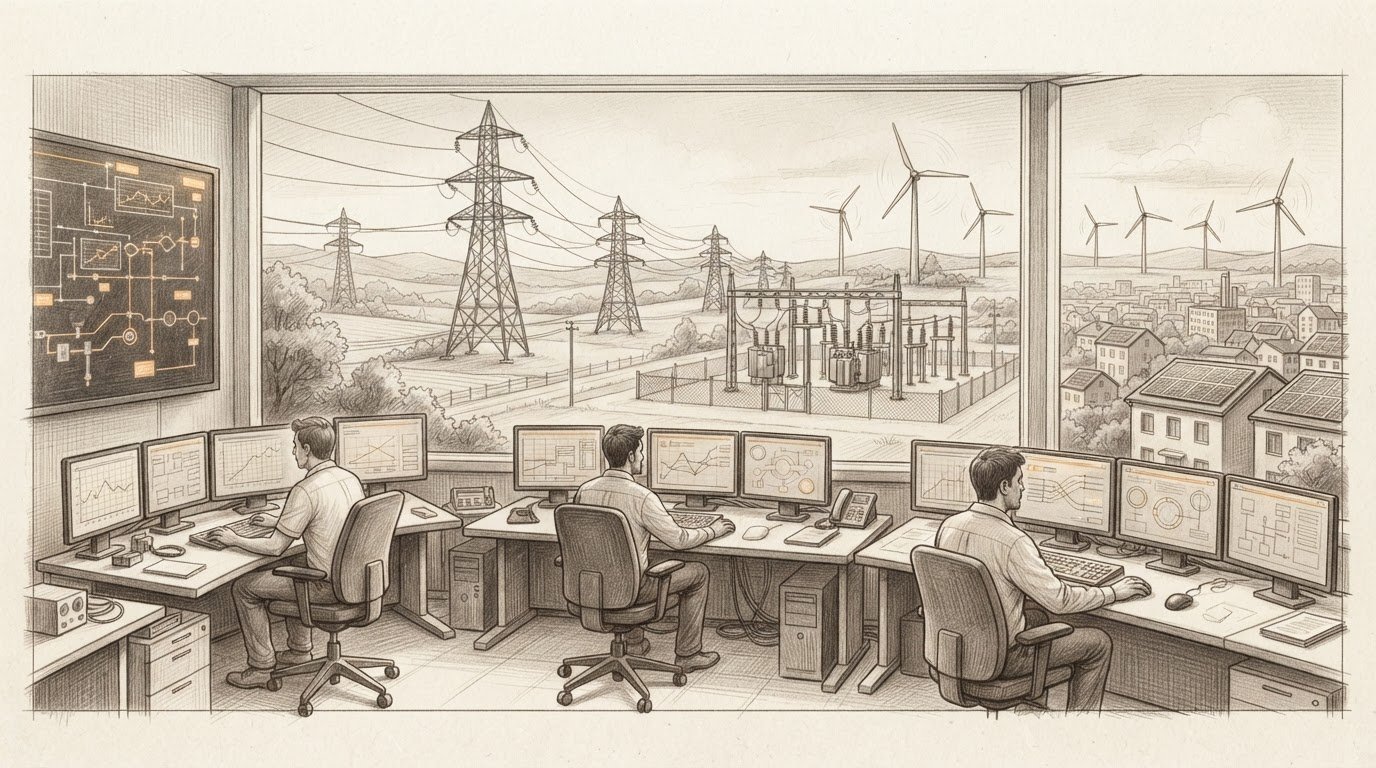
The grid’s century-old control loop — sense, decide, act — assumed a few large, reachable assets. Behind millions of meters now sit solar arrays, batteries, and EVs the operator can neither fully see nor directly act on. More sensors do not fix it: observability is only half the gap, and no dashboard grants reach over millions of consumer-owned devices. The grids that cope stop trying to control the edge centrally and engineer coordination — device autonomy, hierarchy, price signals — in its place.
What to expect
That is the shape of the work: find the constraint the market is talking past, name it, and show how technology behaves once it hits it. Coming issues go deeper into power — grid modernization, new energy scenarios, and the deep-tech use cases underneath them — one constraint at a time.
If this was forwarded to you, you can subscribe at ionpro.in to get each issue when it is published.
Leave a Reply