Ask a utility what is stopping its modernization and the answer usually comes back as a list of technologies it has not yet bought: a better DER management system, a smarter outage platform, an analytics suite. This gets the problem backwards.
Grid modernization is not a shopping problem. It is a sequencing problem. On a grid that cannot be switched off, the live system itself dictates what can be installed and in what order, and the technology menu is almost never the binding constraint. The order is.
The shopping-list fallacy
Utilities are sold, and buy, the top of the stack — the application with the compelling demo. It clears procurement, it is installed, and then it sits idle. Not because it does not work, but because the layers it depends on do not yet exist. The capability was purchased; the ability to run it was not.
This is the quiet condition of a great deal of grid technology: bought, installed, and underused, waiting for prerequisites that were never sequenced. The binding question was never “which technology is best?” It was “what can this grid actually absorb next?” — and that question has a fixed answer the procurement process rarely asks.
The dependency stack
Grid modernization is a stack, and the stack has an order that cannot be skipped. Connectivity comes first: without reliable communications, nothing downstream has a signal. Metering and sensing come next — you cannot manage what you cannot measure. Then a data platform to make the measurements usable. Only then can the advanced applications everyone actually wants — advanced distribution management, DER management, outage prediction — run at all, because each one assumes the layers beneath it already exist and already work.
You cannot run a DER management system before the data platform, before the metering, before the communications. A utility that installs the top of the stack first has bought a roof with no walls.
The smart meter is the clearest case. It is a sensing layer; its value lives in the applications two and three layers above it. Years into AMI deployment in the United States, federal data told the story of a stack built out of order: fewer than 4% of utilities with smart meters had enabled home-area-network gateways, barely 1% offered dynamic pricing, and under a quarter of customers could even see their own daily usage (US EIA Form 861 data, via T&D World). The meters were deployed. The uses that justified them were not — because the rate structures, data platforms, and operational workflows above them were not yet in place.
Why the live system binds
Three properties of a running grid turn modernization into a sequencing problem. It cannot be switched off: every change must be made to a system that is billing, serving, and balancing in real time, so anything that threatens continuity is deferred, however promising. It carries legacy gravity: decades-old assets and vendors set the integration surface, and the new must fit the old, not the reverse. And its binding constraint is readiness, not money: the system absorbs change only as fast as its weakest prerequisite allows.
India’s Revamped Distribution Sector Scheme is this constraint at national scale. Launched in 2021 with an outlay of ₹3 lakh crore, it put smart metering first — the sensing layer the rest of distribution reform depends on. Money was not the blocker: 96% of the year’s funds were utilized. Sequence was. Against a target of 50 million smart meters by March 2025, about 20.8 million were installed, and the Ministry of Power sought to extend the scheme to FY28 (Energetica India, March 2025). The holdups were tendering, testing approvals, and payment-infrastructure — the institutional prerequisites a meter rollout sits on, not the meter itself. A grid that must keep running while it is rebuilt can only change at the rate its slowest foundation permits.
The Brownfield Constraint
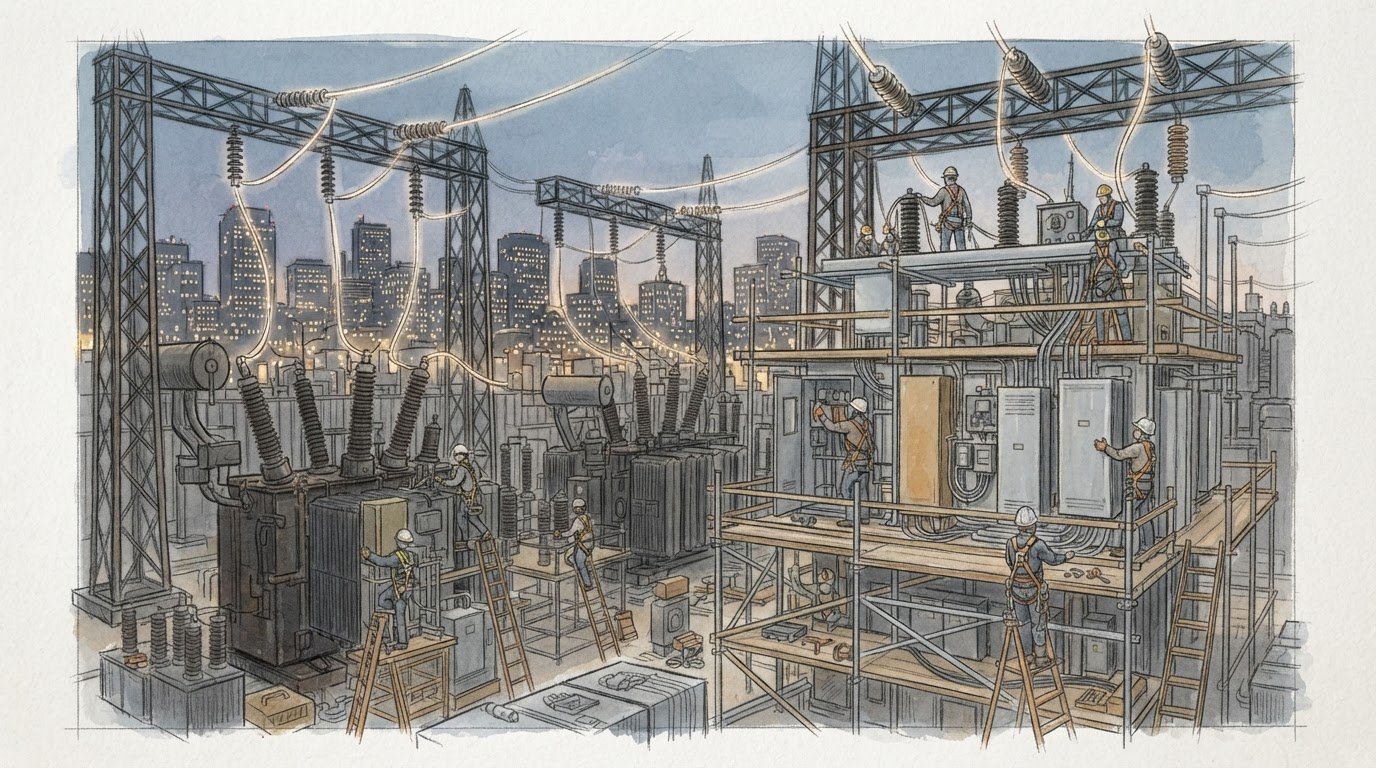
This is the Brownfield Constraint: you modernize a system that must stay on, and the live system — not the technology menu — dominates what is possible and in what order. Utilities never get greenfield. Every upgrade is a retrofit onto a grid that cannot fail and cannot be freely reordered, and that single fact outranks every technology choice.
The honest roadmap starts at the bottom. Connectivity and data foundations before the applications that depend on them. Prerequisites sequenced before capabilities. And the discipline to let a “better” technology wait until the system can actually absorb it, rather than buying it, installing it, and adding it to the pile of capabilities the grid cannot yet run. The utilities that modernize fastest are not the ones that buy the most. They are the ones that sequence honestly and refuse to buy the roof before the walls.
Why this matters now
The pressure to modernize is rising — electrification, distributed energy, climate stress, and the load that AI itself is adding to the grid — and with it rises the temptation to buy the exciting top of the stack first. That temptation is the trap. On a live system, capability bought out of order is capital spent on something that cannot yet run.
The grids that pull ahead will be the ones that respect the order the live system imposes: foundations first, applications last, and the patience to let the sequence set the pace. Modernization does not fail for want of better technology. It fails when the stack is built out of order.
Sources
- US Energy Information Administration, Form 861 data, via T&D World, “How Well Are Utilities Leveraging the Potential Value of AMI Data?” — dynamic-pricing, HAN-gateway, and daily-data-access penetration among US utilities with AMI.
- Energetica India, “Power Ministry Seeks RDSS Extension Till FY28 Amid Slow Progress” (March 2025) — RDSS outlay, smart-meter target and installations, and the extension sought to FY28.
Leave a Reply