Modern infrastructure looks increasingly digital on the surface. Sensors, software platforms, AI-driven optimisation, and cloud dashboards give the impression that infrastructure is finally entering a fast, iterative innovation cycle—much like enterprise IT or consumer technology. That impression is misleading.
Infrastructure systems do not fail or succeed on the speed of innovation. They are governed by something far more restrictive: irreversibility.
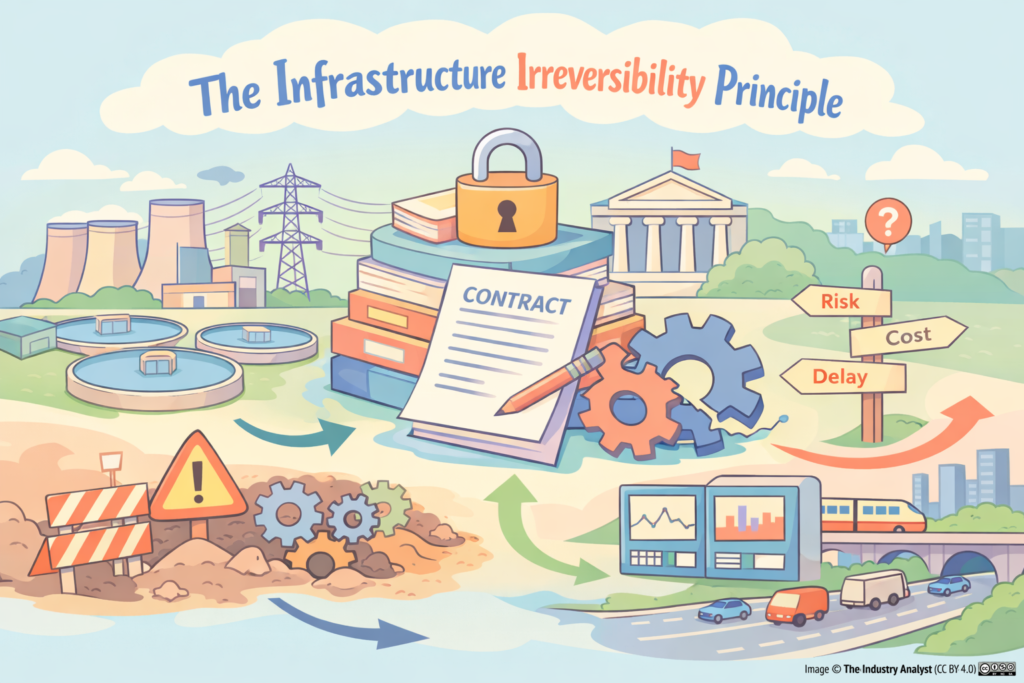
The Infrastructure Irreversibility Principle explains why technology decisions in infrastructure are unusually conservative, why pilots so often stall before scaling, and why legacy systems survive long after they become technically inferior. Once a technology choice is embedded into physical assets, contracts, and institutions, reversing it becomes slow, expensive, and politically sensitive—often more costly than living with a sub-optimal system.
Infrastructure is not constrained by what can be built. It is constrained by what cannot be undone.
Infrastructure Is Not Software
To understand irreversibility, it is essential to reject a common but flawed analogy: treating infrastructure like software.
In software:
- Mistakes are patched.
- Platforms can be replaced.
- Vendors can be switched.
- Architecture can be refactored.
In infrastructure:
- Mistakes persist for decades.
- Replacement often means physical reconstruction.
- Switching vendors may invalidate contracts and warranties.
- Refactoring disrupts public services, safety, and compliance.
Infrastructure is not versioned in releases. It is versioned in generations.
A poor architectural decision in enterprise software may cost productivity for a few years. A poor architectural decision in infrastructure can shape cost structures, reliability, and political outcomes for half a century.
This is the foundation of irreversibility.
The Three Sources of Irreversibility
Irreversibility in infrastructure does not come from a single source. It accumulates through three mutually reinforcing layers.
1. Physical Lock-In
Infrastructure assets are capital-intensive and long-lived by design. Power grids, water networks, transport systems, and industrial facilities are built with expected lifespans measured in decades, not product cycles. Once technology is embedded into physical form, it becomes structurally resistant to change.
Physical lock-in manifests through:
- Proprietary hardware standards embedded in the field
- Network topologies designed around specific technologies
- Operational dependencies between physical assets and control systems
- Maintenance regimes optimised for existing configurations
Replacing software is trivial compared to replacing:
- Meters deployed across millions of households
- Control systems integrated into substations
- Signalling systems woven into transport corridors
- Treatment processes embedded in civil infrastructure
Even when a better technology exists, the question is rarely “Is this superior?” It is “Can we justify dismantling what already works?” Most of the time, the answer is no.
2. Contractual Lock-In
If physical assets make change expensive, contracts make it risky. Infrastructure is governed by long-term agreements precisely because stability matters more than optionality. EPC contracts, concessions, SLAs, PPP agreements, and vendor frameworks are designed to reduce uncertainty—not encourage experimentation.
Contractual lock-in appears in:
- Multi-decade concessions tied to specific technology stacks
- Performance guarantees linked to defined architectures
- Vendor SLAs that penalise deviation from approved configurations
- Financing structures that assume technology continuity
Once signed, these contracts do more than define obligations. They define permitted futures.
Introducing new technology may require:
- Contract renegotiation
- Re-tendering processes
- Legal approvals
- Financial restructuring
As a result, even technically superior solutions struggle to displace incumbents—not because they are worse, but because they are contractually incompatible.
Infrastructure vendors do not just sell products. They sell contract-safe choices.
3. Institutional Lock-In
The deepest and most underestimated source of irreversibility is institutional. Over time, organisations adapt themselves around existing systems:
- Skills are trained for current tools
- Operating procedures align with known workflows
- Regulators approve familiar architectures
- Accountability structures reflect existing risks
Changing technology therefore means changing:
- Job roles and expertise
- Standard operating procedures
- Compliance frameworks
- Responsibility boundaries
Institutional lock-in explains why resistance to change often looks irrational but isn’t.
For the organisation, adopting a new system is not a technical decision. It is a reallocation of risk, accountability, and power.
- Who is responsible if the new system fails?
- Who signs off on safety and compliance?
- Who carries political blame for disruption?
Until those questions have safe answers, institutional inertia will dominate technical logic.
What the Framework Explains
Why Adoption Is Conservative by Design
Infrastructure operators are not innovation-averse. They are failure-averse.
When mistakes cannot be undone cheaply, caution becomes rational. Decision-makers are judged less on how fast they modernise and more on whether they avoid catastrophic errors.
In infrastructure:
- Stability beats novelty
- Proven systems beat optimal systems
- Incremental upgrades beat architectural shifts
Conservatism is not cultural. It is structural.
Why Pilots Rarely Translate into Platform Shifts
Pilots succeed precisely because they avoid irreversibility. They are:
- Isolated from core operations
- Contractually lightweight
- Institutionally protected
Scaling a pilot requires crossing all three lock-ins simultaneously:
- Physical integration
- Contractual commitment
- Institutional realignment
Most pilots fail not because they underperform, but because scaling them would force irreversible commitments that organisations are unwilling—or unable—to make.
Why Legacy Systems Persist Even When Technically Inferior
Legacy systems survive because they are:
- Fully amortised
- Contractually embedded
- Institutionally understood
Replacing them introduces new risks without eliminating old ones. The marginal benefit of improvement rarely exceeds the perceived cost of disruption.
In infrastructure, inferior but predictable often beats superior but uncertain.
The Real Metric of Infrastructure Decisions
This leads to the central insight of the Infrastructure Irreversibility Principle:
Infrastructure decisions are judged not by speed of innovation, but by the cost of being wrong.
The dominant question is not: “Is this the best technology available?”
It is: “What happens if this choice fails—and how hard is it to reverse?”
Until infrastructure solutions are designed with reversibility, modularity, and institutional safety in mind, adoption will remain slow—not because infrastructure is outdated, but because it is responsibly cautious.
Implications for Builders and Policymakers
The principle carries uncomfortable implications:
- Disruption narratives borrowed from software will continue to fail in infrastructure
- Winning strategies prioritise coexistence over replacement
- Modular, interoperable, and contract-aware designs matter more than raw capability
- Institutional alignment is as important as technical excellence
Infrastructure does not need faster innovation cycles. It needs lower-regret decisions.
Those who understand irreversibility do not fight it. They design around it.
And that is where real infrastructure transformation begins.
Read the analysis
Betting the Grid Before the Future Arrives applies the Irreversibility Principle to the decision utilities face now — committing long-lived generation for uncertain AI demand, and why waiting is itself an irreversible bet.